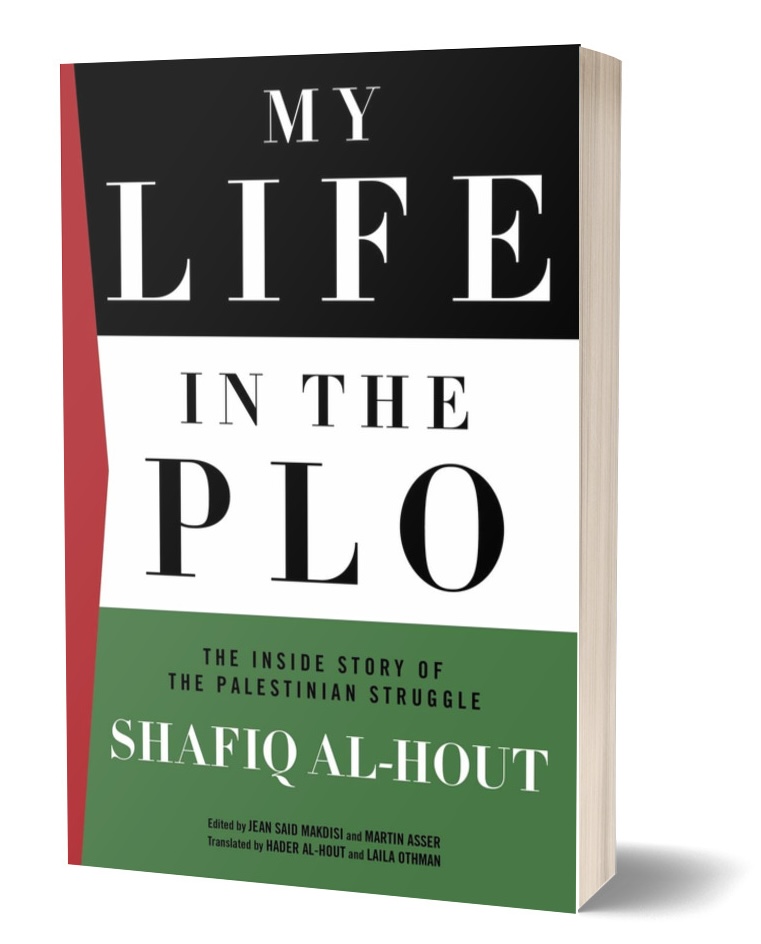
My Life in the PLO: The Inside Story of the Palestinian Struggle by Shafiq al-Hout
Summary and takeaways from the book.
Keywords:
Conversation
Informed
Oct 24, 2025

Author Shafiq al-Hout on left, with Yasser Arafat.
Author
Shafiq al-Hout was member of Executive committee of PLO (Palestine Liberation Organization). He was "
one of the original founders of the Palestine Liberation Organization (PLO) in 1964".
Origin of the PLO
Palestinians had migrated to various Arab countries like Lebanon after the Palestine
Intifada (rebellion, uprising) of 1948.
"
In the early 1960s, the need increased for the creation of a Palestinian organization to try to revive a Palestinian national entity. This was an inevitable result of the failure of the Arab nationalist ideal of union between Arab states, and the resurgence of a narrower and more local nationalism."
"
Upto 1960, Palestinians hoped alliances between Arab states will force Israel to stop repression of Palestinians. This did not happen. So Palestinians could no longer rely on anyone else to save Palestinians in Palestine. "
Dark Times
Author Shafiq al-Hout left Palestine as a refugee after Palestine
Intifada (rebellion, uprising) of 1948.
He went to Lebanon and got a job "
as editor of al-Hawadeth(The Events), which was known for its support of Nasserite Egypt, I had plenty of opportunity to see and hear what was going on, and I contributed to the defense of the Arab union as both idea and state." The motto of the newspaper was "
Arabic ' Political ' Weekly".
"
as editor of al-Hawadeth, which was known for its support of Nasserite Egypt, I had plenty of opportunity to see and hear what was going on, and I contributed to the defense of the Arab union as both idea and state."
"
Thanks to my position at al-Hawadeth, I was fully aware of what was going on inside the Palestinian refugee camps, including the oppression and subjugation of people there, and how any effort to establish any kind of collective action was crushed, even if it was just an educational or sporting initiative."
There was no justice for Palestinians as refugees in Lebanon.
Judges were given sealed envelopes with verdicts for cases. "
Verdicts for this kind of case are always made in advance of the trial. We receive them written and sealed in envelopes: we just open the envelope and read the verdict."
Palestine Liberation Front (PLF)
The author Shafiq al-Hout founded Palestine Liberation Front (PLF). Other organizations were also formed around that time.
"
In the 1960s, the number of Palestinian fronts and organizations increased gradually until finally there were 17 of them, most of which had almost identical goals and programs relating to the liberation of Palestine and the rightful return of the refugees to their homes and properties."
"
I was always keen on achieving rapprochement between the factions of the Arab nationalist movement."
However, merge of groups into one group was problematic. "
Our relationship with the founders of Fatah was problematic and we were in constant disputes with them."
"
One of the reason for disagreement was one group which wanted armed struggle while others did not."
"Another reason was one group wanted "
entanglement" (getting Arab regimes involved in a war against Israel). Others did not want other Arab countries involved and wanted to do it themselves.
One group wanted fight along lines of class struggle.
Another wanted fight along religious lines.
"
Throughout those years, all the efforts by the Arabs and Palestinians to find an effective path to liberate Palestine had come to naught."
Creation of the PLO
"
Egypt President Nassar called for an Arab Summit in 1963 to discuss inter-Arab issues, and relations with Israel. He also said in his speech 'But irrespective of all these problems, we are ready to meet with anyone, for the sake of Palestine.'"
"
In this inter-Arab summit in Cairo Egypt in January 1964, a resolution was passed:"
"Mr Ahmad al-Shuqayri, Representative of Palestine at the Arab League, shall continue to communicate with the member states and the Palestinian people, with the intention of setting the proper foundations for the organization of the Palestinian people, so that they can play their role in the liberation of their nation and acquire self-determination."
"
The wording of the resolution was generic and subtle, and lacked any precise prescription of the mechanisms necessary for the fulfillment of a Palestinian national entity."
"
The Palestinians reacted negatively to the resolution: the various political groups considered it nothing more than an attempt by Arab leaders to divert people from the true path of the revolution already adopted in the mid-1960s by many Palestinian organizations which had raised the banner of military struggle and rejected the suzerainty of the Arab leaders and their League."
"
Following several frustrating rounds of talks with Arab and Palestinian leaders, it was decided that the Palestine National Council would hold its first meeting on May 28, 1964."
"
At last we reached the concluding session: al-Shuqayri, as chairman of the conference, announced the creation of the PLO after its charter and statute were set down, and he was elected its chairman."
"
Four months after the meeting at the InterContinental Hotel in Jerusalem we moved to the Palestine Hotel in Alexandria, where Arab kings and presidents convened on September 5, 1964, for a second summit meeting. Al-Shuqayri delivered a long presentation with the hope of achieving legitimacy for the PLO within an Arab framework."
"
Things could have got out of hand because of the various inter Arab conflicts, especially as every Arab government had its own vision of the anticipated role of the PLO. Some wanted it to be merely an empty shell with the name of Palestine attached, others wanted to abuse it for their own benefit, and yet others wanted to tame it and use it as a bargaining chip."
"The issue might not have been resolved and the PLO might never have achieved the official recognition of the Arab world had it not been for the intervention of Presidents Nasser of Egypt and Ahmad Ben Bella of Algeria.
Iraqi President Abdul Salam Aref added his vote to theirs. Indeed, he went even further and offered, with typical Iraqi generosity, the first payment into the PLO's bank account."
"
Discussions were then concluded, and the establishment of the PLO was approved."
The author was elected chief of Lebanon branch and managed to get Palestine flag flying in Palestine embassy like office in Beirut Lebanon.
Setbacks
"
Things went from bad to worse within the PLO as a result of [PLO President] al-Shuqayri's autocratic methods. He single-handedly initiated a virtual coup within the organization when he announced from the PLO Radio Station in Cairo that the Executive Committee had been relieved of its duties and replaced by a secret Revolutionary Council."
"
I also found out that there was no black and white in politics: gray was the prevalent color.
What hurt me most however, were the mutual grudges between Arab states, which were more intense than those against the common enemy. The only thing that saved me from complete despair was the thundering demonstrations of the Sudanese people, who had come to Khartoum from all parts of the country to receive the Arab leaders and encourage them to fight back and avenge the defeat."
"
...I learned that we were not even invited to participate in the Baghdad Conference, under the pretext that 'the Palestinians had neither money nor economy nor oil.'"
Immediate Impact of PLO
Palestinian refugees lived in refugee camps and were repressed by Lebanese army.
"
...I did not hesitate to tell him directly that his organization should begin taking seriously the significance of the birth of the PLO, and put an end to its policy of repression and terrorization, and that there was urgent need to grant the Palestinians their civil, human, and national rights."
The author went to Lebanese President to complain about repression.
"President Chehab [of Lebanon] did not interrupt me even once and started to talk only after I had had my say. 'I am well aware of the situation you have described, though I must admit, based on what you just told me, that the 'boys' may have gone a bit too far. But I want you to know that this is indeed a deliberate policy.
He noticed our astonishment at his words, and continued: 'In
this part of the world, we are all backward. Each person is backed
by a community or a sect of about 40 or 50,000 people, and so
you cannot control such an issue as yours that easily. You people,'
he said, referring to the Palestinians, 'number about 150,000, all
homeless and desperate. You can see your country across the border
with the naked eye, and yet cannot go to it.
You [Palestinians] turn on the radio and hear that everybody is with you and wants to liberate Palestine, but the truth of the matter is that no one wants to lift a finger.'
He was silent for a moment, then he said: 'I am the one who
established this policy and I am the one who issued strict orders to
the officers, particularly in the south, in the camps and villages, and on the border with occupied Palestine. I have even banned shooting in the air at their wedding celebrations.' Smiling, he added: 'Those people in Israel don't know our customs. Imagine how things might turn out if they were to think we were waging an attack against them, just because a young couple were getting married!' He then returned to his serious mood, and talked about the situation in
Lebanon, its sectarian composition and its corrupt political class.
In the end, he promised that he would make sure that 'the boys'
would behave with less severity and ease off the violations that we
had reported to him.
Fouad Chehab was a man of his word and would never give
a promise he could not keep. After this visit, we noted that the
Deuxieme Bureau loosened its grip and began to build bridges
with the various Palestinian factions that had started to surface in
the Lebanese arena, especially Fatah, which had begun to establish
military bases in the south."
It was only when there was a Palestinian Organization that they had some relief from the repression.
Struggles continue
"
It would be no exaggeration if I said that the PLO embarked on its peaceful engagement with the enemy in exactly the same way that it had engaged in its military engagement, that is with no fixed strategy or any political agenda comprising a list of priorities, mechanisms, or tactics."
"
I had to struggle to establish an internal compromise between those among us who called for the unity of all Palestinian factions and those who favored autonomy and the strengthening of our own organization."
"As I have said before, the Palestinian leadership did not fully grasp the danger of the strategic setbacks it had experienced after its exile from Lebanon."
"I did not want to be like those senior PLO officials who had been infected by the disease of silence which made them put their positions and personal interests above their principles."
Vision for Palestine state
Author wrote about his vision in a detailed study "
What Palestinian state do we want".
He covered:
The name of the state: Palestine
The borders of the state
The capital of the state
The geopolitical situation of the state
Plan for success: "
This would be achieved by establishing institutions, including scientific, intellectual, cultural, and artistic academies at the most advanced levels."
Authors plan for Success for creation of Palestine involved "establishing institutions, including scientific, intellectual, cultural, and artistic academies at the most advanced levels."
Oslo Accord 1993
The Author Shafiq Al-Hout opposed the
Oslo Accord and resigned from the PLO.
"Negotiations are being carried on by people who do not belong to the Executive Committee, are not appointed by the Committee, and are not answerable to it.
The process has come to be dominated by people with posts and titles that do not exist within the formal structure of the PLO, who then appear to go on to become decision makers while the leadership, represented by the Executive Committee, is sidelined and unable to influence the negotiations. This cannot be accepted and responsibility cannot be taken for it, especially as we get closer to the stage when existential decisions will have to be taken.
What we hear today from those so-called advisors, with their sophisticated declarations and attempts to blur the line between what is strategic and what is tactical, no longer washes with anyone.
We, like the rest of our people, have started to sense the dangerous consequences of the risky and complacent politics being played by the leadership in the name of the Executive Committee."
* * *
Author Shafiq Al-Hout died in 2009.
"
Al-Hout has died a disappointed and frustrated man, his life's work, for the foreseeable future, buried in a divided and moribund PLO and a Palestinian national movement in the worst straits in its 50-year history." Source:
The Guardian
Palestinian president Mahmoud Abbas eulogized him as one of the core group that founded the PLO as well as a former member of its Executive Committee, and awarded him [posthumously] the Star of Honor medal - Palestine's highest award.
Related articles
Israel: A History by Anita Shapira
The Making of Modern Zionism: The Intellectual Origins of the Jewish State by Shlomo Avineri
External Links