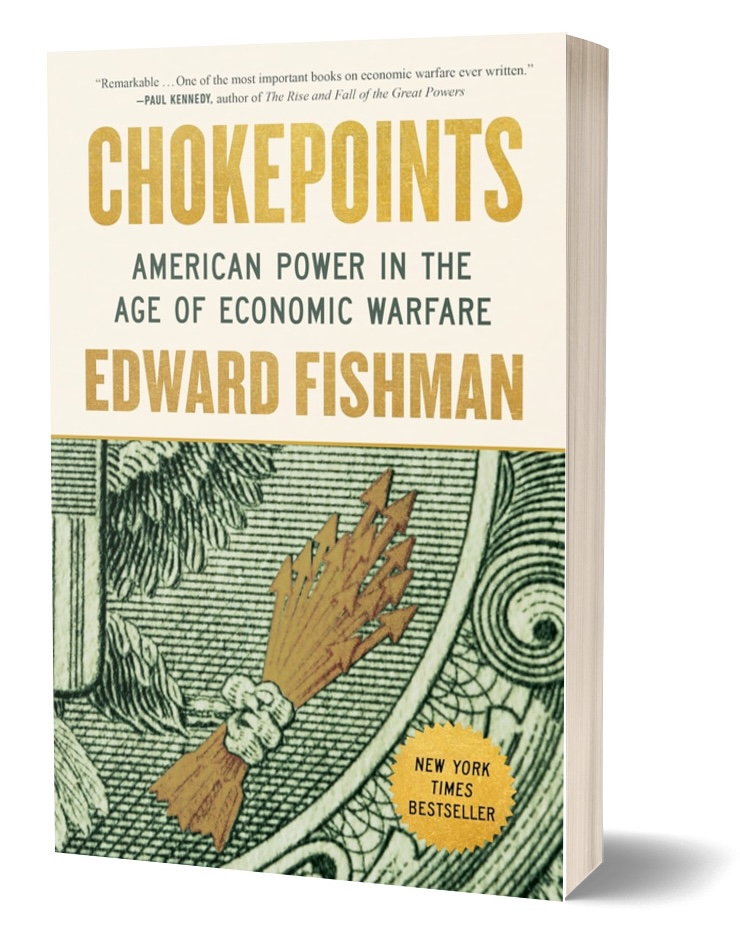
Edward Fishman "served at the U.S. Department of State as a member of the Secretary's Policy Planning Staff... he was the Russia and Europe Lead in the State Department's Office of Economic Sanctions Policy and Implementation, where he played a central role in designing and negotiating international sanctions in response to Russia's aggression in Ukraine".
Chokepoints are strategic vulnerabilities.
This is an excellent and very well researched book on Economic Warfare by a person who has been involved in economic sanctions policy making and implementation.
"This is economic warfare. It is how America fights its most important geopolitical battles today."
Economic warfare is non-violent but just as damaging as conventional warfare. As the author says, economic warfare can shutdown a bank or a corporation just as effectively as conventional warfare.
Nature of International Finance
"The 'galloping new system of international finance,' the American financier Walter Wriston wrote in 1988, was 'not built by politicians, economists, central bankers or finance ministers, nor did high-level international conferences produce a master plan.' On the contrary, it was built by 'the men and women who interconnected the planet with telecommunications and computers' and the bankers who 'immediately drove their trades over the new global electronic infrastructure.'
Wriston was the most powerful banker of his time, leading Citibank from the late 1960s to the mid-1980s. He twice turned down offers to serve as the U.S. secretary of the treasury: as the top CEO on Wall Street, he knew public office would not confer any economic or political privilege he did not already enjoy."
This electronic infrastructure includes "CHIPS (the world's leading system for settling payments) and the Society for Worldwide Interbank Financial Telecommunications, or SWIFT (a messaging service for banks that became a lingua franca for international finance)."
"In his 1992 manifesto The Twilight of Sovereignty, published a year after the collapse of the Soviet Union, Wriston predicted that national governments would grow obsolete as the twin forces of finance and information technology took command of the levers of history."
This was true for some time. In the late 1990's, America was reluctant to weaponise their control of international finance. Market Forces dominated.
"Within the Clinton administration, Robert Rubin, the powerful treasury secretary and former Goldman Sachs co-chairman, worried that any measures to instrumentalize the dollar for overtly political ends might 'undermine the role of the dollar as the reserve currency' and push other countries away from the U.S. financial system. 'Once you do it once,' Rubin said, 'you become a less reliable supplier.' The U.S. economy was booming, the Cold War was over, and the geopolitical environment was mostly benign, so why take any risks?"
This changed over time. "The United States has used its hold over these chokepoints to pioneer a new, hard-hitting style of economic warfare. The result has been a stunning resurgence of state power in a world supposedly governed by market forces."
Economic warfare
"Economic warfare has always offered one path to this goal. Depriving an adversary of money, resources, and other fruits of commerce can sap its will, compelling it to make concessions.
Even if the enemy refuses to give in, economic warfare can degrade its industrial capacity and weaken its military, hindering its ability to fight should armed conflict break out."
Ideas are a dime a dozen
"In Washington, where policy ideas are a dime a dozen, it's rare for any initiative to get by on intellectual merit alone.
More often, it takes a complex network of backers'politicians, businesspeople, thought leaders, and voters, each with divergent priorities and interests'for anything to get done."
Dominance of US Dollar
"Every night I ask myself why all countries have to base their trade on the dollar... Why can't we do trade based on our own currencies?" - Lula da Silva, President of Brazil.
India traded with Brazil not in Rupees or Real but in US Dollars.
"no one required companies around the world to use the dollar for cross-border transactions; they did so because of its convenience and reliability, and because there was no good alternative."
"United States had taken active steps to propel the dollar to its lofty status, starting with the creation of the post'World War II Bretton Woods system and the Marshall Plan."
USA also created SWIFT and CHIPS.
China and most other countries had capital controls as well unlike the US Dollar. "Chinese officials also helped sustain the dollar's role, albeit inadvertently, by prioritizing the CCP's authoritarian control rather than reforms that might enable the renminbi to compete with the dollar internationally."
"The renminbi has a long way to go until it can match the dollar in terms of the depth and liquidity of U.S. capital markets and the ease of moving across borders."
America has a fairer and transparent legal system. "And when deals go sideways, most executives would rather find themselves in an American courtroom than a Chinese one."
"BRICS had been a loose coalition whose internal rivalries overshadowed any recognition of mutual interests. The quintet was once hyped by Wall Street as the next engine of global economic growth'its name had been coined by a Goldman Sachs economist'but in practice it was a talk shop with no serious geopolitical purpose."
Dangers of Incrementalism
"Instead of unleashing the full force of their economic arsenal immediately after Russia annexed Crimea, American officials spent months crunching numbers and negotiating with allies before settling on sanctions a fraction as potent as those they had wielded against Iran."
"The world economy was still recovering from the 2008 financial crisis, and Europe remained especially fragile. Under these circumstances, driving Russia off an economic cliff seemed too risky. There was also political risk in sanctioning Russia: American businesses had real skin in the game, and Congress wasn't nearly as enthusiastic about isolating Russia as it had been about Iran. And of course, European support for sanctions was always a question mark. Heavily dependent on Russian energy, the EU had a lot to lose from a protracted economic struggle with its eastern neighbor."
"In the end, the West's caution proved a costly error. It allowed Russia to absorb the initial shock of sanctions and then carry on much as it had before."
As the author says, "Sometimes it's best to go big or go home.".
"If there's a central lesson of the economic war against Russia, it is that deferring hard choices does America no good."
"U.S. officials found themselves playing catch-up to address long-festering problems or unforeseen crises."
Economic warfare and strategic vision
"For the United States to prevail in future economic wars, it will need to pair its economic might with strategic wisdom."
"Still absent, however, was any clear strategy to prevent China from chipping away at the load-bearing pillar of U.S. technological primacy: the semiconductor industry."
"Despite the frequency with which it uses sanctions and export controls, America has hardly perfected the art of economic war. On the contrary, the U.S. government continues to rely on an ad hoc process and a rudimentary policy apparatus.
Compared with the way the Pentagon prepares for conventional war'including recruiting and training professional troops, devising plans, and rehearsing them repeatedly 'the U.S. agencies responsible for economic war are still playing in the minor leagues."
"sanctions have the potential to work, but only if they're administered in strong enough doses over a long enough period to avoid resistance. This is the problem both Obama and Biden faced in confronting Russia: they ratcheted up sanctions incrementally, giving Russia time to adapt and build up resistance along the way. As a result, neither president delivered a knockout blow to Russia's economy, which, at least in Biden's case, was the goal. Sometimes it's best to go big or go home."
Retaliation to Economic Warfare
"...foreign adversaries could take comfort in the fickleness and fecklessness on display in Trump's treatment of ZTE and Rusal. The U.S. president was quick to anger and quicker to submit when either of his favored constituencies, American CEOs and foreign autocrats, complained. Faced with pushback from these quarters, Trump would reverse course even if he got nothing in return and regardless of the criticism he was sure to face from hawks on Capitol Hill and in his own administration."
"In the years to come, fighting and winning economic wars will only get harder, especially as China and other countries strengthen both their offensive capabilities and their defensive fortifications."
"Every age contains within it the seeds of its own destruction... For almost three decades, the [Bretton Woods] system worked: from the rubble of war emerged a world economy more dynamic and productive than ever before. Countries torn apart under the stress of years of combat, dictatorship, and military occupation blossomed into prosperous welfare states. The French fondly remember this era as les trente glorieuses, or the glorious thirty.
But the core features that once made Bretton Woods successful eventually caused friction. Fixed exchange rates, originally considered a guarantor of stability, became a source of distrust and resentment. Multinational corporations found ways to dodge capital controls, and their efforts gradually won backing from a few self-interested governments. When Bretton Woods met its demise in the early 1970s, it collapsed under the weight of its own design."
Generals of Economic Warfare
"Successful economic warfare requires an interdisciplinary toolkit: the legal acumen of an Adam Szubin, the diplomatic skill of a Dan Fried, the regional expertise of a Matt Pottinger, and the economic creativity of a Daleep Singh."
The Impossible Trinity
"The trade-offs facing policymakers in Washington, Beijing, Brussels, and Moscow can be thought of as an impossible trinity consisting of economic interdependence, economic security, and geopolitical competition.
Any two of these can coexist but not all three."
If we want to have a globalized world with economic interdependence, benefits of efficiency and low prices, States will have economic insecurity and geopolitical competition.
If we want economic security and geopolitical security, we cannot have economic interdependence. This is the world we are moving to.
* * *
The books deep dives into several economic wars that America has fought with Iran, Russia, and China. The books covers in "detail four consequential episodes between 2006 and the present, a period I call the Age of Economic Warfare."
The outcome of this 'Age of Economic Warfare' was 'Economic fragmentation' (deglobalization).
This is best illustrated by this anecdote mentioned by the author.
President Trump went to China in 2017. "The next day, Trump and his advisors met Xi's second-in-command, Premier Li Keqiang. Li treated them to a history lesson of his own, the conclusion of which was that China's modernization was now complete and that the country no longer needed the United States for technological innovation.
Moving forward, America's role would be to supply China with food, oil, and other commodities.
Trump may have wanted to help U.S. farmers sell more soybeans, but he still couldn't stomach Li's depiction of the United States as a hinterland of the Chinese economic empire."
Summary of weapons of economic warfare:
Sanctions: e.g. price caps on Russian oil
Secondary Sanctions: sanctions on those who trade with sanctioned entity.
Price Caps: e.g. price caps on Russian oil
Freeze foreign exchange reserves: e.g. America froze $300 billion of Russian foreign exchange reserves.
Denying insurance: makes export and import risky
Mercantilism: Although not mentioned by the author, "Mercantilist economic policies aimed to build up the state, especially in an age of incessant warfare, and theorists charged the state with looking for ways to strengthen the economy and to weaken foreign adversaries." Mercantilism is used to strenghten one's own State and corporations, and punish other States and foreign companies.
Export ban of crucial technologies and resources: e.g. rare earth minerals, AI chips, and high tech machines.
Tariffs
The future of economic statecraft with Daleep Singh
ISBN: 979-8301510427
Published: November 27, 2024
Pages: 187
Available on: amazon
What do we do
We provide original analysis, provoke thought, and enlighten on issues relevant to all of us.
We are here to make sense of this changing world.
What makes us right
We are right because we base our words and actions on history, humanity, and our shared common values. That is enough to help us navigate through the information minefield and noise. We are uncorrupted by favor or influence, and have vested interest in being right.
We live by what we say. We thrive and flourish in the world we live in. We have no safety net. If we are wrong, we see the effect in our daily life immediately.
Our ideas are battle tested in the real world everyday by us. You should too.